
Feral Hogs Don’t Understand Fencelines
The feral hog problem is not just a trapping problem. It’s a coordination problem. New op-ed in The Washington Post.

I have a new op-ed, paywall-free here, in The Washington Post today explaining that trapping and controlling feral hog populations isn’t simply a technology problem. It’s a coordination problem.
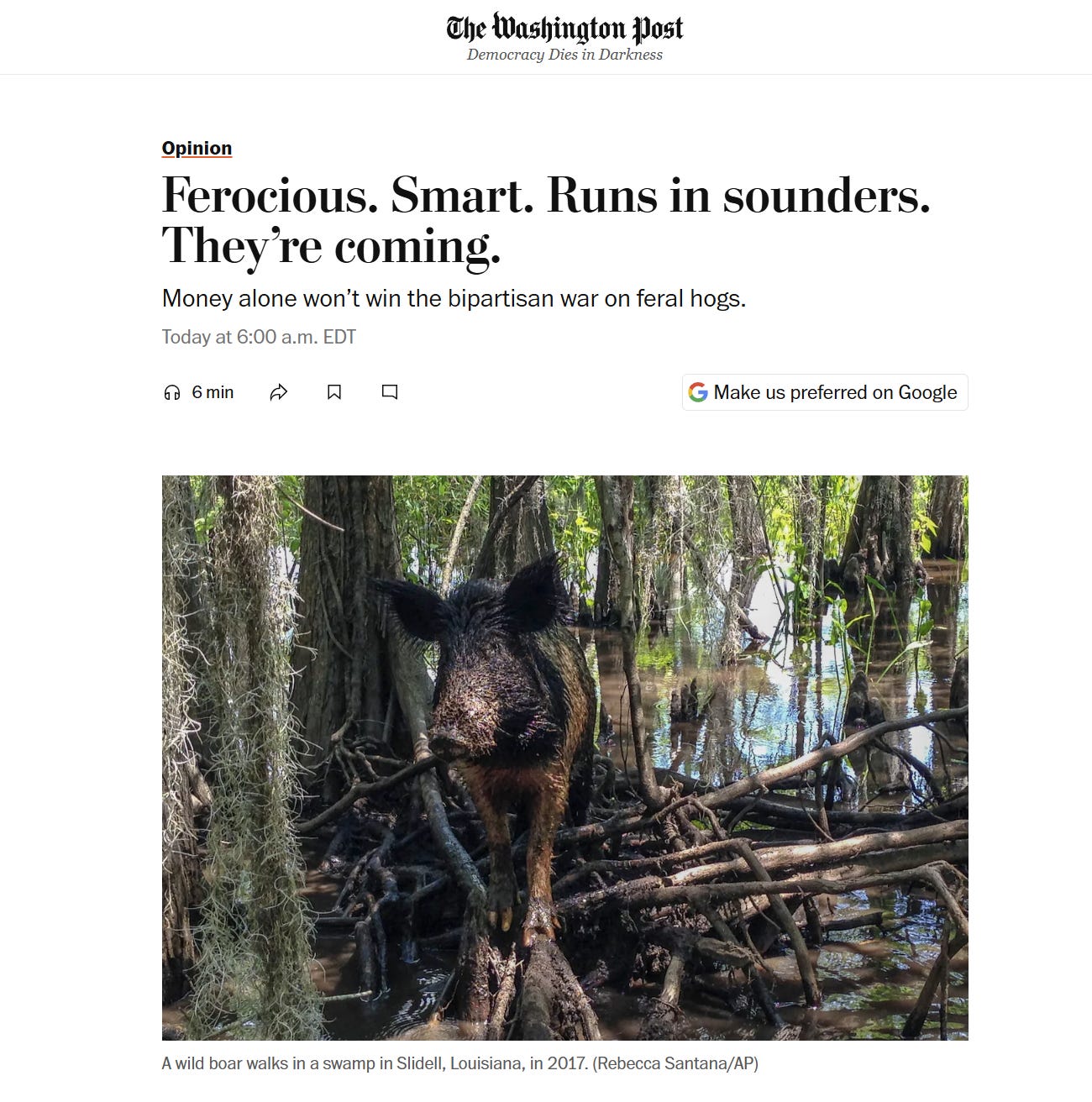
Feral hogs have been spotted in at least 35 states and are encroaching on rural, suburban, and increasingly urban spaces. They’re the ultimate chaos goblins: omnivorous, hardy, destructive, and extremely good at multiplying.
And feral hogs are incredibly smart.
I learned this firsthand as an intern in southern Oklahoma a decade ago. If a hog senses danger or has seen a trap before, it can teach a whole sounder of pigs to avoid it. Then they move right on over to the neighbors.
Technology such as smart traps and drones can make trapping easier. But those tools only go so far when hogs can cross the fence to properties where no one is trapping, or where people have incentives to keep them around.
Which leaves us with a coordination problem.
I wrote about what that means, why Congress should take the issue seriously, and why the right number of feral hogs in the United States probably is not zero, but definitely is not 7 million either.
I’d love to hear what readers think I’m missing, especially from folks who have dealt with feral hogs directly, worked on invasive species management, or thought about the weird policy space between private land, public damage, and collective action. Feel free to leave a comment below or shoot me a message!
As always, I have an exhaustive list of people to thank for feedback and letting me bounce ideas off of them. Huge thanks to Grant Mulligan, Andrew Miller, Rhishi Pethe, Hiya Jain, Mike Riggs, Elizabeth Van Nostrand, Emma McAleavy, and for reading multiple versions of this piece. All mistakes are my own.