
Farm Productivity Research Has a People Problem
Restoring public ag R&D won’t be enough if universities no longer train the economists who translate farm research

In May, Dan Blaustein-Rejto wrote for Breakthrough Institute about the drift of public agricultural research from farm productivity. He was writing as the White House proposed eliminating the Hatch Act funding, roughly $250 million a year that land-grant universities use disproportionately for production-oriented research. Blaustein-Rejto notes that real public spending on agricultural research has already fallen by a third since its early-2000s peak. I agree wholeheartedly that such cuts would threaten a long tradition of agricultural innovation in the United States. I also think his diagnosis stops one step short, at the money, when a more upstream challenge is people. As funding has drifted, so has the attention of agricultural economics at our institutions. While not the only department involved in applying for and conducting publicly funded agricultural research, agricultural economics departments often supply the economists on interdisciplinary grant teams. Ag economists are responsible for helping calculate costs, understanding a producer’s objective function, and identifying factors that drive adoption. Even if funding is restored, the pathway for people doing this kind of work is thin. Who will do the research and train a new generation?
I was trained as a production economist. In the field of agricultural economics, the subfield of production economics is deeply intertwined with the study of farm management. Economists in the field have contributed by establishing links between cost and supply response, integrating economic theory into farmers’ decisions, assessing agricultural productivity, and understanding the role risk plays in farm decisions1. Often, we work closely with other related disciplines such as agronomy and animal science. They supply scientific know-how while we assist with statistical analysis, economic feasibility, or even bring in behavioral economics to understand on-farm adoption. Blaustein-Rejto offers a nice example that illustrates this division of labor. Hatch-funded researchers at Utah State showed that grazing cattle on a mix of grasses and legumes can cut nitrogen fertilizer while maintaining animal performance. Usually, these types of projects are a team effort. An animal scientist asks biological questions and designs experiments to test hypotheses while working in tandem with other folks who establish that it is an economically viable strategy, at what fertilizer prices, for which operations, and whether a rancher facing real costs and real risk would ever adopt it. Those folks are production economists.
Unknowingly, I’ve been training to be a production economist my whole life. As a kid, my favorite activity was going to work with my dad (Bob). Bob is a ruminant nutritionist, meaning he makes rations for cows. We’d cruise the countryside, listening to classic rock, Bob swapping phone calls with herdsmen and feeders. A haystack caught fire, the load of cottonseed wasn’t going to make it today, milk prices crashed, a rash of displaced abomasums cropped up, my dad deftly doing mental math, making ration swaps, saving the day. I’ll never forget one such phone call, Bob asked little me what the goal was and little me eagerly blurted out, “Maximizing milk production!”
And that was the day I learned the correct answer was maximizing profits2.
Somewhere in the middle of my undergrad, a couple of faculty members recognized my lifelong proximity to production agriculture and took an interest in my future. In the 1900s, when life was more agrarian and Earl Heady’s production economics was ascendant at Iowa State, it was easier to find some farm kids, teach them calculus and production functions, and send them on to a PhD program. As farm numbers have dwindled, it is increasingly difficult to find students with a background in production agriculture. I was rare.
Finding a place to take my talents was even more difficult. Agricultural economics departments have shifted significantly in the past 30 years. Throughout the 90s and early 2000s, Gregory Perry surveyed agricultural economists, asking them to rank the top PhD programs by field. In the published 1999 rankings, respondents ranked 11 schools in Production.3 In the 2004 rankings, even after Perry broadened the category to “Farm Management, Finance, and Production,” respondents could name only four. In a 2010 article, Perry wrote openly about the field’s drift away from helping farms become more profitable.
Perry’s last published survey is from the early 2000s. He was trying to measure reputation, what departments his peers thought of when asked about “production.” I cannot replicate that. Instead, I did some digging into current PhD requirements in agricultural economics (or in economics departments that offer a specialization in agricultural economics). Oklahoma State University, Kansas State University, Texas Tech University, and Washington State University require a production course for PhDs. It looks like Louisiana State University and the University of Nebraska-Lincoln offer a production course as an elective.
These are different metrics from what Perry proposed. I cannot map my findings directly onto his. But the two point in the same direction. And the lack of PhD programs providing production as part of the core curriculum puts ambitious potential PhD students in a bit of a bind. For example, I ended up at Oklahoma State University (OSU). While I received offers from better-ranked departments, upon declaring my intentions to continue in the tradition of “cows and crops,” I had one celebrated agricultural economist tell me to stay put in Oklahoma. He felt that his department had little to offer me. I got off the call feeling conflicted. While I really wanted the rigor of a top-tier program, I understood the faculty there had little interest in my ideas. I chose to stay.
The decline of departments known for production economics coincides with the timeline laid out by the Breakthrough Institute. In the data they provided, state agricultural experiment stations devoted about two-thirds of their R&D to farm production in the 1970s and 80s. Today it’s about half. In remarks from 2010, Perry suggests that the decline in production in agricultural departments is due to waning student demand and college funding.
Now perhaps, if more funding were allocated to areas such as farm productivity, faculty and students would express more interest. That tracks. However, realistically, with four schools continuing the production economics core, who trains a young production economist?
The educational prospects of a production economist
One of the courses I took during grad school was taught by B. Wade Brorsen. He is a legend of the field. There’s no textbook. Brorsen stands in front of the class, lectures mostly from memory, and takes his students through in-class exercises daily. His class was the first time most students studied topics like expected utility and risk, but it’s also a crash course in agricultural topics. I was dinged on exercises for making incorrect assumptions about nitrogen application or not thinking through the biology of cattle. Brorsen aims to instill tacit knowledge, the “No shit, Sherlock” things that would allow a farmer to punch holes in even the fanciest econometric methods. The handwritten notes I have from this class rank in my top five possessions, somewhere behind the rocking chair my grandfather handmade and the pearl earrings my husband gifted me after the first deployment we went through together. Brorsen aims to retire soon. I cannot stress to you what a loss that is to the field. There’s not a whole lot of folks with his experience to replace him.
The ecosystem of a production economist
Our professional organization, the Agricultural and Applied Economics Association (AAEA), has its roots in the American Farm Management Association, which was founded in 1910. In 116 years, I think it’s good that our profession has “expanded beyond the farm gate!” There are so many spheres that food and fiber touch. These interests are represented in the AAEA’s 30+ sections. None of these sections are for production economics or farm management. While not having a corresponding section isn’t the end of the world, one would think having a listserv of folks in the community who express interest in production economics could be useful.
Looking at the sections, I am assuming the association believes that anyone with an interest in production will select into the Agricultural Finance and Management, Agricultural Innovation and Productivity, Specialty Crop Economics, Applied Risk Analysis , or Extension sections.
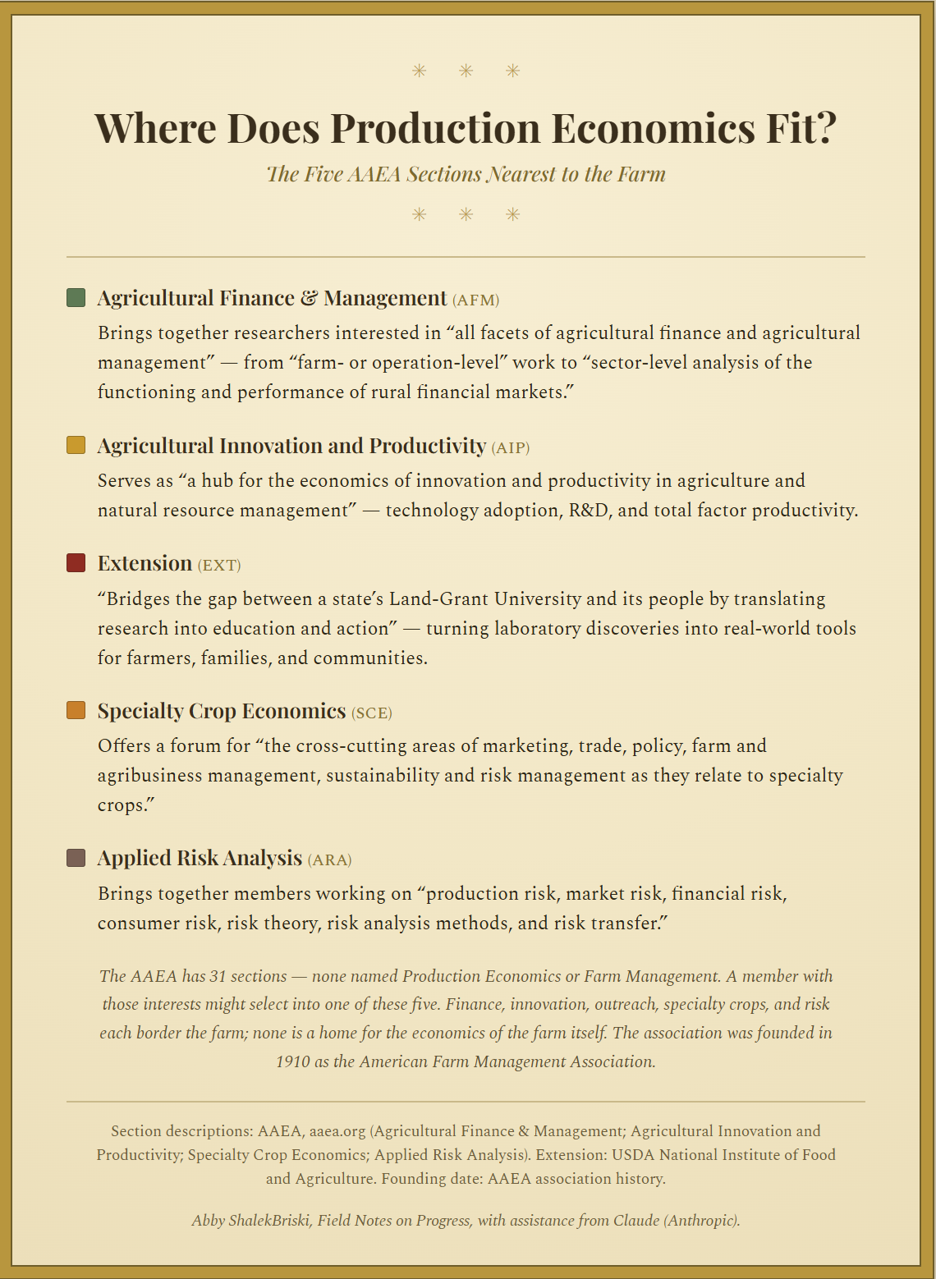
All these sections overlap with one another and the premise of production economics. I would like to highlight the section that I think of as much a verb as a noun. Extension acts as outreach and applied-research delivery. It takes research at land-grant universities and translates it into practical knowledge for farmers, producers, families, communities, etc.
If we’re interested in conducting and disseminating research that continues to address farm productivity and other associated topics, extension is important! In the age of AI, I believe the value of extension economists who conduct on-farm visits, organize meet-ups and workshops for producers, communicate with the media ecosystem, and have a real “boots-on-the-ground” presence in their local communities will continue to increase. Due to the very applied nature of these positions, some of the better production economists I know have at least part of their appointments allocated to extension.
Extension has been experiencing a decline. A paper published this year in Agricultural and Resource Economics Review documents a nationwide decline in extension staff. Borisova et al. claim that in 1979, 17,694 professional extension staff existed in the United States. They estimate today that there are approximately 13,188. There are a couple of caveats to this. The count includes far more than agricultural economists; it covers everyone with extension in their job description (program associates, local county agents, etc.). Regardless, these numbers document a strain that many of my friends feel.
There are many plausible reasons for the decline of extension. Sometimes farmers can simply Google the answers, ask their Claude or ChatGPT for advice, or hire a private consultant or company. However, since positions have declined and the breadth of topics covered has expanded (think 4-H, rural community development, etc.), we can assume the number of Agricultural economists employed as extension economists is on the decline as well. These jobs do exist, and getting experience before graduation is TOUGH. As an anecdote, in 2016 Oklahoma State University had a one-credit course that allowed you to learn about and practice extension. Today, it doesn’t exist. Additionally, faculty who are 100% or majority extension may have little incentive to take on graduate students. A lot of their time is spent on the road, in the field, etc. Typically, they produce fewer publications than their colleagues who are research-focused. Their metrics of success deal much more with media appearances, workshops taught, presentations given, and extension publications (think a couple-page practical guide on a topic meant for producers, farmers, agribusiness professionals).
Once again, I ask, who will be left to train our students?
The reality of a production economist
Appointments with an extension component might seem like a good fit for new graduates with a background in production. However, the reality is that such positions might be highly undesirable for strong job market candidates. New research from the Journal of Extension suggests that salaries at land-grant universities’ extension faculty are lower than those of non-Extension faculty. This salary discount becomes most prominent at the full professor level. In the sample, the mean salary difference for professors with extension appointments versus those without is $14,532. Why would top talent be interested in an appointment that will pay them LESS money on average? NO THANKS.
There’s also a second story here. Prestige. All my friends and I have a running joke. Submitting something production-oriented to our top journal (or even a field journal like Applied Economic Perspectives and Policy, or one of the regional journals) leads to a desk rejection within the hour. Again, if you’re an exceptional agricultural economist, why would you take an interest in a production problem if you know the likelihood of it being placed in a top journal is slim?
One hypothesis we have for our journal-submission woes relates to the decline in production economics in PhD programs. With fewer students being exposed, there are fewer editors and referees with experience in topics like production economics, risk, farm management, etc.
Understanding and measuring this “vibe” my colleagues and I have about looking for places to submit production-oriented research is hard. Not a lot of empirical evidence exists. The most recent mapping of the agricultural economics space was done by Cei, Defrancesco, and Stefani in the European Review of Agricultural Economics. They perform topic modeling across 11,000 abstracts and seven journals spanning 1964-2020. Their dataset includes abstracts from Food Policy, American Journal of Agricultural Economics, Journal of Agricultural Economics, Agricultural Economics, Australian Journal of Agricultural and Resource Economics, European Review of Agricultural Economics, and the Canadian Journal of Agricultural Economics. The model sorts the literature into fourteen topics that group into four clusters: Markets, Resources, Policy, and Production. The Production cluster holds four subtopics, namely Rural issues, Farm economics, Agricultural production and technology, and Modelling and methodology.
When looking at the Production cluster, it becomes obvious that Farm economics, Agricultural production, and Rural issues have held steady. These categories bounce between 5% and 8% of the literature over the past six decades. The Modelling and methodology category has fallen off a cliff. The authors note that these quantitative approaches, led largely by American scholars until the mid-1990s, characterized the analysis of the production and efficiency papers.
The topic model groups Modelling and methodology with the other production topics because their language co-occurs in abstracts. While there are many plausible explanations for the decline, e.g., no one is working at the forefront of methodologies, there’s a whole list of journals not included in this analysis, etc., Cei and coauthors’ results suggest another option.
Perhaps topics related to farms, production, and rural communities didn’t decline. Perhaps the field changed methods.
How production has changed
Jesse Tack, Jisang Yu, and Roderick Rejesus tackle the latter in a recent Food Policy paper. In their paper, “Recent approaches in agricultural production economics: Where the heck are the prices?” Tack and company chart the rise of reduced-form methods in production research: difference-in-differences, instrumental variables, matching, etc. Tools that are crucial to the modern microeconomist. The authors call this trend Recent Agricultural Production Approaches (RAPA). These approaches all rest on the premise of causal identification, being able to understand cause and effect.
The previous generation of agricultural economists working in production was part of the duality revolution. The core of duality is that a producer’s technology and a producer’s behavior are two sides of the same coin. If farmers maximize profits, the underlying production process is encoded in how they respond to prices. So instead of estimating a production function directly, which requires input data that farmers choose (and is therefore endogenous, meaning both a cause and an outcome), you estimate a profit or cost function using prices, which the farmer takes as given. This allowed choice problems, problems with some optimal mix of inputs producing outputs, to become tractable.
Which is the joke in Tack et al.’s title. RAPA doesn’t need prices. If your question is whether a new technology raises yields, you can control for prices with fixed effects and identify the effect without ever putting a price in the model. To the duality generation, this is heresy. The authors quote the rallying cry: “the maximization of profits, as opposed to yields, is the true goal of producers.”
Without getting bogged down in the econometric weeds, let me say this. RAPA methods are incredibly powerful. Just like the discovery of duality, RAPA is providing agricultural economists with deeper insights into climate change, crop insurance, other on-farm programs, and the adoption of genetically modified organisms. I’m sure the next decade will lead to even more innovations in methodology.
Which is exciting! However, as these tools have been brought into production from microeconomics, I wonder if their very portability has made us lazy as a discipline. The identification toolkit looks similar regardless of the applied problem, which means a department no longer needs to teach production economics to produce production research. The econometrics sequence covers it.
I’ve written before about how few of the people writing about agriculture have any direct proximity to it. The same dynamic is at work here.
The people problem
We started with Blaustein-Rejto’s chart: public dollars drifting away from farm productivity since the 1980s. He’s right, and I think we should push for funding to return to these topics. But I think about this a lot. Even if we restore funding, are we providing our students with the right training to build research programs that matter to producers, agribusiness professionals, and policymakers? Are we creating incentives that entice top talent into production economics?
This matters. As Blaustein-Rejto points out, the USDA has explicitly stated that “Increasing Profitability of Farmers and Ranchers” is a key priority for the administration. In the USDA priorities, promoting soil health for long-term productivity and protecting American agriculture from invasive species (if you haven’t read my op-ed on feral hogs, self-recommending) are two other places that directly intersect with production economics. While many folks think of the field as maximizing crop yields per acre, it’s much more expansive. We deal with problems like preventing a decline in productivity, for example, methods or treatments that improve long-term land and environmental health, disease pressures, etc. We’re interested in helping producers be financially solvent through farm finance, farm management, crop insurance, and other risk management tools.
There is still demand for production economists. The job postings ask for the skill set every year. There are endowed chairs with farm productivity written into them. They exist! And they aren’t asking “do you know causal identification strategies?” They’re asking for well-rounded candidates with experience and knowledge of crops, livestock, farm finance, crop insurance, land use, and precision agriculture technologies. The market wants both: modern methods and the ability to understand how a research program can impact a farm, ranch, or agribusiness in practical ways.
A fair critique might be “hasn’t student demand for this fallen?” Among graduate students and junior faculty, in some ways it has. But walk into an undergraduate classroom at a land- grant university and you’ll meet students who want exactly this. These students want the fundamentals to take back to a family operation, get a job in industry, or start their own agribusiness. A common comment from young faculty teaching an undergraduate Farm Management section is that their students spend a lot of time correcting them on the principles of farming and how unrealistic the class examples are. (I can confirm that I was an 18-year-old poking fun of a faculty member because she didn’t know anything about a dairy. Sorry, Gina. I’ve since been the victim since moving to Oklahoma due to my ignorance about the stocker cycle.) The demand is there. We need faculty who can engage with our students on these topics.
Blaustein-Rejto defends the Hatch formula funds because they give universities the long-term certainty to invest in things that take decades, like field sites and long-running experiments. Behind this research is the longest-term investment: a person. A production economist takes five or six years to train and hopefully continues to learn and contribute for decades to come. Funding is the fast variable. People are the slow ones.
And while we can redirect funding, reprioritize productivity and progress, we cannot simply conjure production economists without a pathway. We need people who are willing to learn production systems. Opportunities to interface with producers. Mentors to pass down tacit knowledge. Coursework that teaches not only the methods but the things the methods point at: production theory, agronomy and biology underneath it, the economics of a whole operation rather than one parameter of it. Places to publish. And real value, in money and in prestige, for the people who work on applied problems and carry knowledge out of the university, like extension economists.
Somewhere out there is a girl with two braids down her back, in a pickup cab with her grandpa, in the tractor with her momma, watching a drone fly over the neighbor’s crops, around the dinner table talking cows with her family. Someday, someone is going to tell her she can think about the problems of production ag for a living.
The question is whether anyone will be left to train her.
Many thanks to Rhishi Pethe, Hiya Jain, Duncan McClements, Elizabeth Van Nostrand, Jannik Reigl, Deric Tilson, and Mike Riggs who all provided feedback on various versions of this piece. A special thanks to Whoi Cho and Clint Neill who were willing to provide their perspectives as agricultural economists. Any errors are mine.
For an overview of 100 years of production and farm management, please see Chavas, J. P., Chambers, R. G., & Pope, R. D. (2010). Production economics and farm management: a century of contributions. American Journal of Agricultural Economics, 92(2), 356-375.
The correct answer is maximizing expected utility. But this is not something a five-year-old can conceptualize, and my dad was not trained as an economist.
This was difficult to find. Please DM or email me if you would like a PDF of the 1999 survey results.
This is interesting to me as a glimpse into the sociology/professional norms of a field I know nothing about. My understanding is that in social psych/econ/political science, if a person wants to become a public figure and work mainly on public communication -- if they want to be the extension person in their subfield —they just sort of start doing it. I suppose the difference is what you get rewarded for in the tenure process and job market (but Raj Chetty, Emily Oster, Betsy Levy Paluck, Gary King, etc. can clearly manage both). So it's just interesting that all this gets explicitly sorted out at the job description level in ag econ.